
Plymouth County Court Records After Arrest
After a Plymouth County arrest, the jail record and the court record are two different public-record tracks. The Plymouth County Sheriff's Office inmate roster, maintained by the office led by Sheriff Jeff TeBrink, is a custody tool. The inspected public roster PDF is titled current only and shows date booked, cell, inmate name, ID number, and age. It does not show the filed criminal complaint, the trial information, the court case number, bond orders, or the final disposition.
The court record begins when the criminal case is entered in the Iowa court system. The Plymouth County Clerk of District Courts directs users to Iowa Courts Online for case information, forms, and fine payments. The case record is where a reader checks the charge filed by the prosecutor, hearing dates, warrant events, amendments, dismissal, plea, trial result, sentence, and financial obligations. Booking facts can be useful, but the court record controls the case history.
For jail custody or booking details, the better internal reference is the Plymouth County jail inmate records page. Booking photos are a separate topic because the current-only roster PDF does not display them; the Plymouth County jail mugshots page explains that records route. Court records after a jail arrest should be read as allegations and case events unless the court record shows a conviction, deferred judgment, dismissal, or other disposition.
Find Plymouth County Court Records After Arrest
The official case-search route is Iowa Courts Online. The portal is statewide, so a Plymouth County arrest may need a county filter, exact spelling, or a case number if the person has a common name. The research file notes that the live portal's detailed dynamic fields were not fully captured, so exact search controls should be confirmed in the live portal. The known access path is still clear: search the defendant name or case number, narrow to Plymouth County District Court when possible, and open the criminal case result.
- Confirm the name spelling from the newest Plymouth County roster PDF, a sheriff press release, citation, warrant paperwork, or jail phone confirmation.
- Open Iowa Courts Online and search by party name or case number. If filters appear, narrow the search to Plymouth County or criminal case records.
- Compare the arrest or booking date with the case filing date. A new case may not appear at the same moment the person is booked.
- Open the case and review filed charges, status, hearing dates, bond orders, warrant events, attorney appearances, and disposition fields.
- If the case is too new, sealed, confidential, or hard to match, contact the Plymouth County Clerk of District Court for the public-access route.
A court-search screenshot captured from the official Iowa Courts Online landing page shows the same case-search source named by the Plymouth County Clerk.
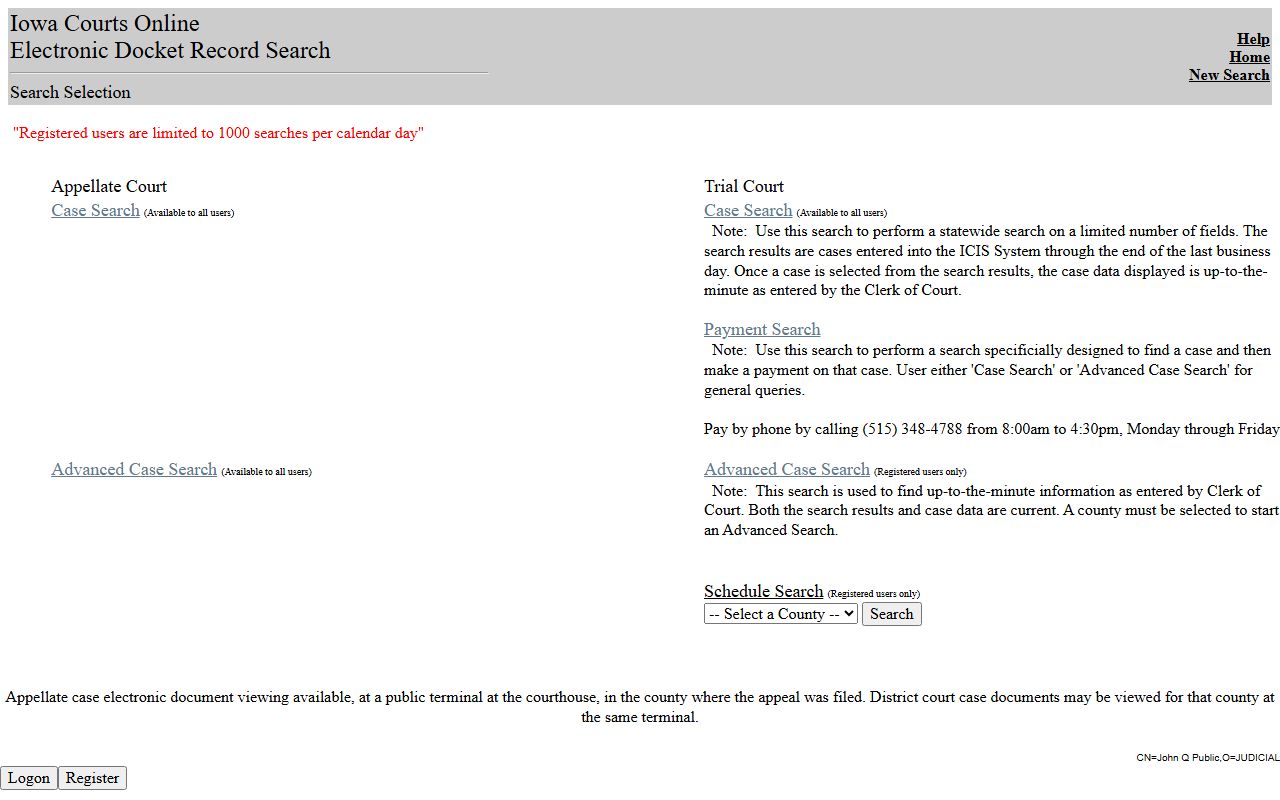
That court portal matters because court records after a Plymouth County arrest are not searched through the jail roster. The roster confirms current custody, while Iowa Courts Online is the official path for the criminal case record.
Plymouth County Court and Attorney Offices
Plymouth County criminal cases are handled through Iowa Judicial District 3. The Clerk of District Court is at Plymouth County Court House, 215 4th Ave S.E., Le Mars, IA 51031. The clerk phone is 712-546-4215, fax is 712-546-8430, and courthouse hours are 8 AM to 5 PM Monday-Friday. The county clerk page also lists clerk Amy Berntson and Chief Judge Patrick H. Tott.
Plymouth County Clerk of District Court
Plymouth County Court House
215 4th Ave S.E.
Le Mars, IA 51031
712-546-4215
Open 8 AM to 5 PM Monday-Friday
Plymouth County Attorney
Plymouth County Courthouse
215 4th Ave SE
Le Mars, IA 51031
712-546-5019
The local prosecutor is Plymouth County Attorney Darin J. Raymond. Iowa uses the county attorney title, not district attorney. The county attorney page says the office appears for the state and county in court, prosecutes preliminary hearings for charges triable on indictment, prepares informations and bills of indictment, enforces forfeited bonds and recognizances, and handles other criminal duties. In plain terms, this is the office that turns an arrest and booking into filed court charges when prosecution goes forward.
Plymouth County Arrest Charging Documents
The first jail entry may use arresting-agency language. The court case uses a filed charging document. That difference matters because a sheriff press release or booking note may list one set of alleged offenses, while the County Attorney later files, amends, reduces, or dismisses charges. Iowa Code definitions also recognize arrest data and charge filing by preliminary information, so the case record should be checked before treating a booking description as the final charge list.
| Document | What It Does | Plymouth County Context |
|---|---|---|
| Complaint or preliminary complaint | States the first sworn accusation or facts supporting the criminal allegation. | Often appears near the arrest or first court filing stage. |
| Preliminary information | Records charge filing by a peace officer or law-enforcement officer in Iowa arrest-data terms. | May explain why arrest information and court information do not match word for word. |
| Trial information or information | Formal prosecutor-filed charging document used in Iowa criminal practice. | The county attorney page says the office prepares informations. |
| Indictment | Grand-jury charging document. | The county attorney page says the office attends grand jury when necessary and prepares bills of indictment. |
Plymouth County Charge Status Records
Charge status changes as a case moves. A person may be booked on a warrant, released before the next roster PDF, and still have an open criminal case. A person may also appear in Iowa Courts Online while no longer listed on the current-only jail roster because they bonded out, were transferred, were sentenced, or were never held long enough to appear on a later PDF. Court records after a jail arrest are best read by charge, not just by case title.
| Status | What It Means | Why It Matters |
|---|---|---|
| Pending | The charge is still open and has not reached final disposition. | A pending charge is not a conviction. |
| Amended or reduced | The filed charge changed after review, plea talks, or a court order. | The final case may differ from the arrest description. |
| Dismissed | The court record shows the charge was dropped or ended without conviction. | Check whether other counts remain open. |
| Deferred or plea result | The case resolved under a plea or deferred judgment path, if ordered by the court. | Read the disposition and sentence terms closely. |
| Sentenced | The court imposed sentence after conviction or plea. | Lookup may move from county jail to Iowa DOC after transfer. |
Plymouth County Bond After Arrest
Bond information may appear in court records, jail phone confirmation, or selected sheriff press releases. It does not appear in the inspected Plymouth County current-only roster PDF. The sheriff's News & Records archive has examples of arrests where bail was described as cash or surety, but those releases are not a complete bond ledger. For a current release question, call the jail and check the case record for bond orders.
| Bond Type | How It Works | Local Caveat |
|---|---|---|
| Cash bond | Cash is required in the amount or portion ordered by the court. | Payment location and method were not published in the researched jail PDFs. |
| Surety bond | A private bail bonding agency posts bond under its own terms. | The jail posts a bonding-agency list, but the list is not an endorsement. |
| Personal recognizance | Release is based on a court order and promise to appear. | Confirm in the court record or with counsel. |
| No-bond hold | The person remains held until the court or holding agency clears release. | Warrants, out-of-county holds, DOC, federal, or ICE issues can affect release. |
Plymouth County Arrest Warrant Records
No official Plymouth County active warrant search database was located. The sheriff's Most Wanted page has selected names and photos, but it is not a complete warrant list and includes a warning that information or photos may be in error. The Civil Division page says the division processes mittimus and arrest warrants, and press releases show warrant arrests that led to booking at Plymouth County Jail.
A warrant can connect to court records in more than one way. A new arrest warrant may start a new criminal case, while a bench warrant can appear in an existing case after failure to appear or failure to comply. A mittimus can direct custody after a court order or sentence. Search Iowa Courts Online for case-linked warrant events, call the clerk for court-record questions, and use the Sheriff's Office for surrender or custody logistics.
- Arrest warrant
- A court order authorizing arrest based on probable cause or a filed charge.
- Bench warrant
- A warrant issued by a judge, often after a missed court date or failure to follow an order.
- Mittimus
- A court commitment document that can direct jail or prison custody.
- Hold or detainer
- A notice from another agency that may keep a person in custody after local bond is addressed.
Plymouth County Charges vs Convictions
A charge is an allegation. A conviction is a court result. That distinction is required reading for court records after an arrest because jail booking, sheriff press releases, and early complaints can be seen before a case is resolved. Iowa Code section 692.2 requires released criminal-history data to include the statement that an arrest without disposition is not an indication of guilt.
| Point of Comparison | Charge | Conviction |
|---|---|---|
| Stage | Accusation filed or alleged after arrest. | Final result after plea, verdict, or other court finding. |
| Proof | Based on probable cause or charging decision. | Requires the legal standard tied to guilt or plea. |
| Change risk | Can be amended, reduced, added, or dismissed. | Can still be affected by appeal, deferred terms, or later record relief. |
| Best source | Iowa Courts Online, complaint, information, indictment, and clerk records. | Disposition, sentencing order, and court docket. |
Plymouth County Sealed vs Expunged Records
Public access has limits. Iowa Code section 22.2 gives broad access to public records unless another law restricts the record. Criminal-history and arrest data are also governed by Iowa Code section 692.1 and section 692.2. Juvenile, sealed, confidential, medical, investigative, victim, and nonpublic criminal-history information may be withheld or restricted.
| Point of Comparison | Sealed | Expunged |
|---|---|---|
| Public visibility | Hidden or restricted from ordinary public view by law or court order. | Removed or treated as unavailable under the qualifying order or statute. |
| Where to check | Clerk of District Court and the originating agency. | Clerk of District Court and any agency holding the affected record. |
| Effect on online search | A public portal may omit or limit the record. | A public portal may no longer show the case or event. |
| Key caution | Some officials may still have limited lawful access. | Do not assume third-party copies change without a separate request or order. |
Restricted Plymouth County Court Records
Not every arrest-related record is public in the same way. Juvenile court and social records have confidentiality rules under Iowa law. The Iowa DOC open-records page draws similar lines for sentenced-offender data by listing public fields while making medical, psychiatric, psychological, Social Security, family, financial, evaluation, security, and some non-conviction history confidential. County jail and court records should be read with those limits in mind.
For records not available through Iowa Courts Online, use the office that holds the record. The Sheriff's public-records page accepts requests by telephone, U.S. mail, email, or in person, with review by the sheriff, reasonable response time, and reasonable charges. The clerk handles court-file access, certified copies, and case questions. The County Attorney is the prosecutor, not the court clerk and not the jail records custodian.
Important: Arrest without disposition is not an indication of guilt, and restricted records may require clerk or agency review.